In the digital era, your reputation often enters the room before you do. Whether you are applying for a job, seeking an investor, or meeting a new client, the first thing they will likely do is Google your name. What they find—or don’t find—can be the deciding factor in your success.
The stakes have only gotten higher with the rise of artificial intelligence. Search engines are no longer just lists of links; they are sophisticated systems that summarize information, pull data from obscure corners of the web, and construct narratives about individuals in seconds. AI search tools like ChatGPT, Google’s Gemini, and Microsoft’s Copilot can aggregate decades of digital footprints into a single, cohesive profile.
This shift means that casual posting, forgotten social media accounts, and old news articles carry more weight than ever before. Managing how you are perceived online is no longer a vanity project reserved for celebrities and politicians. It is a critical component of professional survival.
For many, navigating this complex landscape alone is overwhelming. This is where personal reputation management services step in. Companies like SanMo BD specialize in curating, protecting, and enhancing digital identities, ensuring that the story the internet tells about you is the one you want to be told.
The Evolution of Online Search: From keywords to AI Narratives
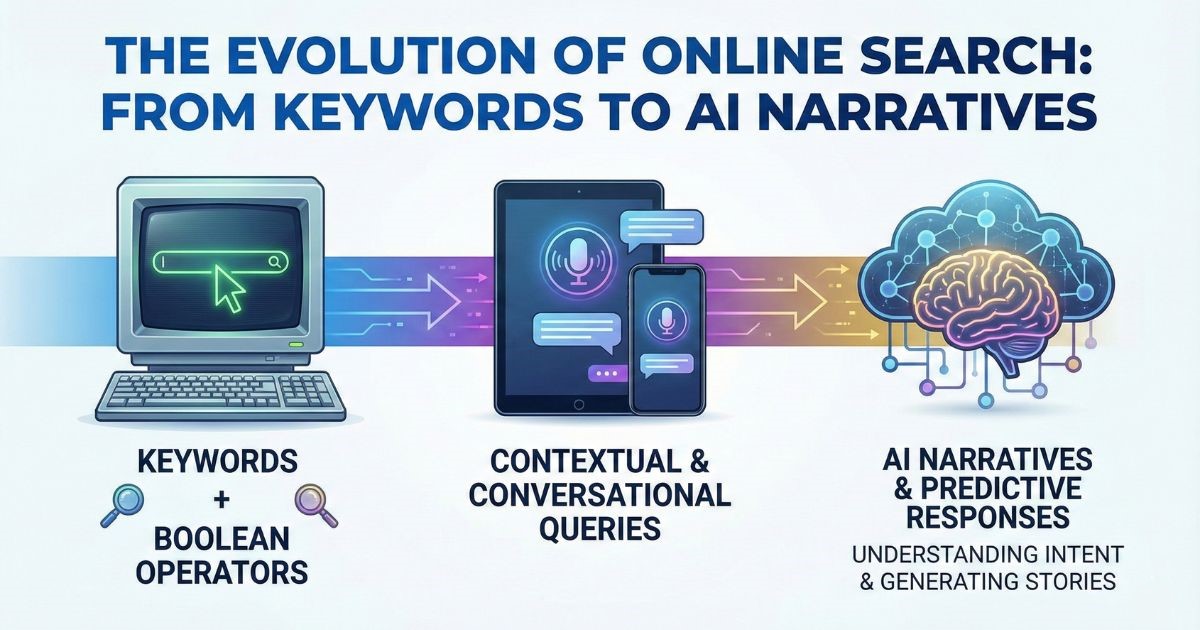
To understand why reputation management is crucial, we must first look at how search has changed. Ten years ago, Googling a name might have brought up a LinkedIn profile, a Facebook page, and perhaps a local news mention. If there was negative content, it might have been buried on page three or four, where few people bothered to look.
Today, the landscape is vastly different. Search algorithms prioritize relevance, recency, and authority. But the real game-changer is AI-generated search experiences (SGE). Instead of presenting a list of blue links, these tools provide a synthesized answer to a user’s query.
If someone asks an AI tool, “Who is John Doe and is he trustworthy?”, the AI doesn’t just look for keywords. It scans news reports, court records, social media comments, blog posts, and reviews to generate a summary. If the dominant data points are negative—even if they are outdated or taken out of context—the AI’s summary will reflect that.
The Permanence of the Digital Footprint
One of the most dangerous misconceptions about the internet is that content disappears over time. In reality, the digital footprint is stubborn. Wayback Machine, cached pages, and data scrapers preserve content long after the original source is deleted.
Personal reputation management services understand the technical infrastructure of the web. They know that deleting a tweet isn’t enough if a screenshot exists on a third-party aggregator. They monitor the deep web and surface web alike to identify potential threats before they become prominent parts of your narrative.
Why DIY Reputation Management Often Fails
Many professionals attempt to manage their own reputation. They might tidy up their Facebook privacy settings or write a few LinkedIn articles. While these are good first steps, they are rarely sufficient against a sophisticated algorithm.
DIY efforts often fail because they lack consistency and technical know-how. Pushing down a negative search result requires a sustained strategy of content creation, search engine optimization (SEO), and backlink building. It involves understanding domain authority and how to signal to Google that a new, positive piece of content is more relevant than an old, negative one.
Furthermore, reacting emotionally to negative content can often make it worse—a phenomenon known as the Streisand Effect. Engaging with a troll or arguing in a comment section signals to algorithms that the negative content is “engaging,” prompting platforms to show it to more people. Experts at SanMo BD provide the objective, strategic distance needed to handle these situations effectively.
The Risks of a Neglected Digital Reputation
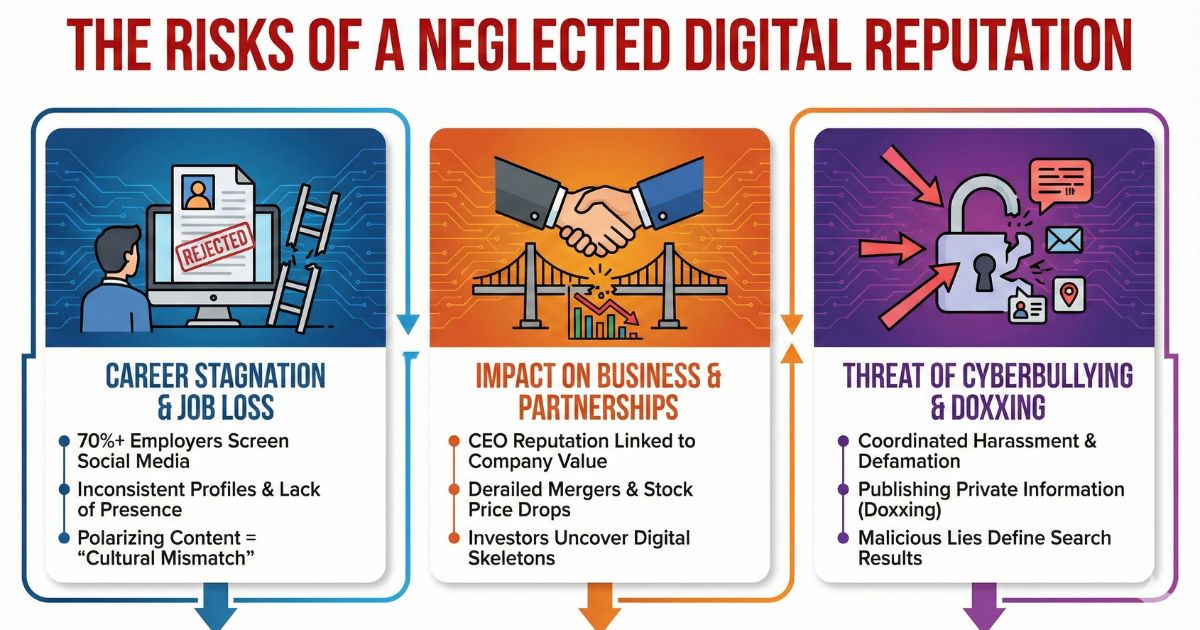
The cost of a poor online reputation can be quantified in lost opportunities. In a highly competitive global market, trust is the currency of business. If your digital presence erodes that trust, the financial and professional consequences can be severe.
Career Stagnation and Job Loss
Recruiters and hiring managers routinely use advanced screening tools to vet candidates. A survey by CareerBuilder found that over 70% of employers use social media to screen candidates, and more than half have found content that caused them not to hire a candidate.
Red flags aren’t always obvious scandals. They can be subtle:
- Inconsistency: Your resume says one thing, but your public profiles suggest another.
- Lack of Presence: In some industries, having zero digital footprint is viewed with suspicion, suggesting a lack of modern skills or industry engagement.
- Polarizing Content: aggressive political rants or unprofessional interactions can mark a candidate as a “cultural mismatch.”
Personal reputation management services help align your digital persona with your professional goals. They ensure that when a recruiter searches for you, they find a consistent, professional, and impressive candidate.
Impact on Business and Partnerships
For entrepreneurs and executives, personal reputation is inextricably linked to company reputation. A CEO with a questionable past can tank a stock price or derail a merger. Investors conduct rigorous due diligence, and they will uncover any digital skeletons.
SanMo BD works with executives to build “reputation firewalls.” By populating the first page of search results with high-quality thought leadership, press releases, and verified profiles, they create a buffer that protects the individual—and by extension, the company—from inevitable crises or attacks.
The Threat of Cyberbullying and Doxxing
The internet can be a hostile place. High-profile individuals are often targets of coordinated harassment campaigns, doxxing (the publishing of private information), and defamation.
Managing these attacks requires swift legal and technical intervention. Reputation management firms often work alongside legal teams to issue takedown requests for defamatory content that violates platform terms of service. They also implement suppression strategies to ensure that malicious lies don’t become the defining feature of a person’s search results.
How Personal Reputation Management Services Work
It’s easy to think of reputation management as simply “deleting bad stuff,” but the reality is far more proactive and holistic. It is about asset building. The goal is to create a robust, positive digital ecosystem that is so strong it naturally suppresses negative or irrelevant content.
Strategic Content Creation
Content is king, but context is queen. You cannot simply spam the internet with fluff pieces and expect Google to rank them. The content must be high-quality, relevant, and authoritative.
Services like SanMo BD employ teams of writers and SEO specialists to create:
- Thought Leadership Blogs: establishing you as an expert in your field.
- Press Releases: announcing genuine achievements and milestones.
- Guest Articles: placing content on reputable third-party sites to build high-quality backlinks.
- Video Content: YouTube videos rank highly in Google search, offering a powerful way to control the visual narrative.
SEO and Asset Optimization
Creating content is only half the battle; people have to see it. This is where technical SEO comes into play. Reputation managers optimize personal websites and social profiles for specific keywords associated with your name.
They ensure that your LinkedIn, Twitter, Crunchbase, and personal website interlink effectively, creating a network of validation that search engines trust. This “authority network” signals to AI search tools that these are the definitive sources of truth about you.
Review Management and Monitoring
For doctors, lawyers, and small business owners, personal reputation is often tied to reviews. A smear campaign of one-star reviews can destroy a practice.
Reputation management services utilize software to monitor mentions of your name across the web 24/7. When a negative review appears, they can advise on the best course of action—whether that involves disputing a fake review with the platform or drafting a professional, de-escalating response that demonstrates your commitment to customer service.
Wiki and Knowledge Panel Management
Having a Google Knowledge Panel (the information box that appears on the right side of search results) provides instant credibility. However, claiming and managing this panel can be tricky. AI search often pulls directly from these panels.
Specialists can help verify your identity with Google to claim your panel. They can also suggest edits to ensure the information displayed is accurate and flattering. For those who qualify, creating and monitoring a Wikipedia page is another high-level service that adds immense “domain authority” to a personal brand.
The Role of AI in Reputation Management
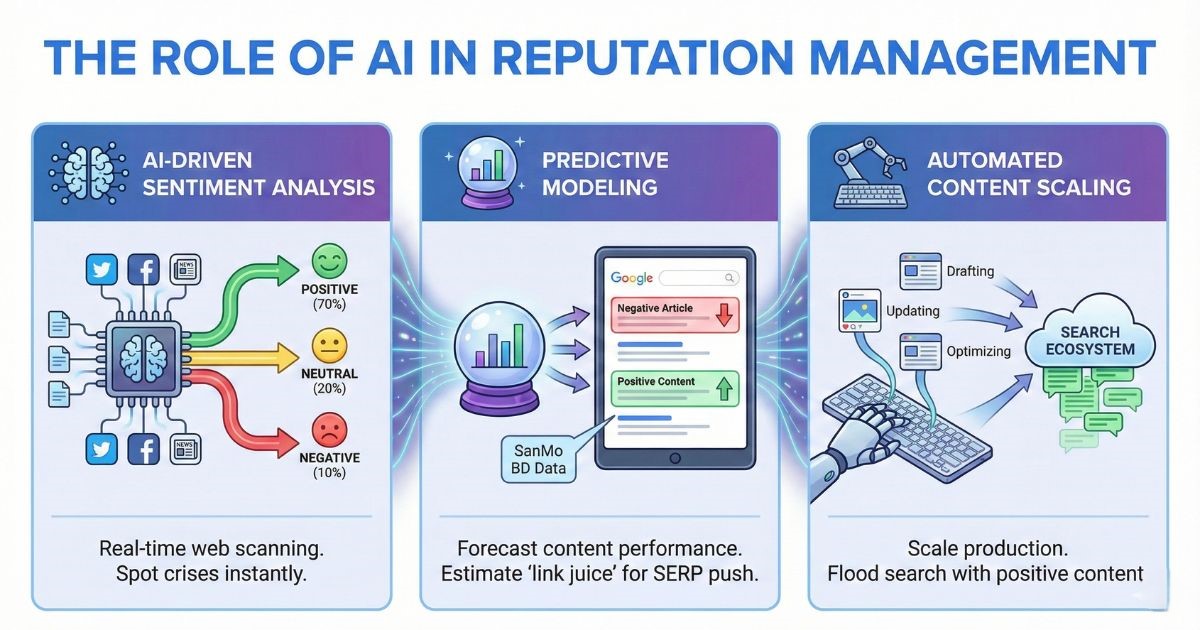
Ironically, the very technology that complicates reputation management—AI—is also the key to solving it. Leading firms are now using AI to fight fire with fire.
AI-Driven Sentiment Analysis
Manual monitoring is impossible when thousands of mentions happen daily. AI tools can scan the web for sentiment, instantly categorizing mentions as positive, negative, or neutral. This allows reputation managers to spot a bubbling crisis before it boils over.
Predictive Modeling
Advanced analytics can predict how a specific piece of content will perform. Before launching a PR campaign, SanMo BD can use data modeling to estimate how much “link juice” is needed to push a negative article off the first page of Google. This moves reputation management from a guessing game to a data-driven science.
Automated Content Scaling
While high-level strategy requires human insight, AI can assist in scaling content production. It can help generate topic ideas, draft social media updates, and optimize headlines for click-through rates, allowing for a higher volume of positive content to flood the search ecosystem.
Why SanMo BD Stands Out in Reputation Defense
In a crowded market of agencies promising to “scrub the web,” SanMo BD distinguishes itself through a focus on ethical, long-term strategies. They understand that there are no magic buttons to delete the past. Instead, they focus on building a future that outshines it.
Their approach is rooted in transparency. Clients are not kept in the dark about the strategies being used. Whether it is aggressive SEO, legal takedowns, or brand building, SanMo BD partners with clients to ensure the digital narrative aligns with their real-world values.
Furthermore, they specialize in the specific nuances of the AI search age. They don’t just optimize for keywords; they optimize for entities. They ensure that AI understands who you are, not just what you do, ensuring that generative search results are accurate and favorable.
Future-Proofing Your Name
We are moving toward a world where our digital twin is as important as our physical self. As augmented reality (AR) glasses and deeper AI integration become the norm, people may soon be able to pull up your “reputation score” simply by looking at you.
This sounds like science fiction, but the infrastructure is already being built. In this reality, personal reputation management services are not a luxury; they are an insurance policy. They protect your most valuable asset: your name.
Investing in these services is an investment in your autonomy. It is the decision to define yourself, rather than letting an algorithm define you. Whether you are a college graduate entering the workforce or a seasoned CEO planning a legacy, taking control of your digital narrative is the most empowering professional move you can make.
Frequently Asked Questions (FAQ)
What exactly do personal reputation management services do?
Personal reputation management services monitor, protect, and improve how you appear online. This involves suppressing negative search results, creating positive content (like websites and articles), managing online reviews, and optimizing social media profiles to ensure the first page of Google reflects your best professional self.
Can reputation management companies delete negative news articles?
Generally, no one can simply “delete” a news article from a third-party website unless it violates specific laws (like defamation or copyright infringement). However, companies like SanMo BD can use suppression strategies. This involves creating high-quality, optimized positive content that outranks the negative article, pushing it to the second or third page of search results, where it is rarely seen.
How long does it take to fix a negative online reputation?
Reputation management is a marathon, not a sprint. Google’s algorithms take time to re-index new content and adjust rankings. While some changes can happen in a few weeks, a comprehensive campaign to suppress strong negative results usually takes 6 to 12 months of consistent work.
Is reputation management only for celebrities or people with scandals?
No. In the age of AI search, everyone needs reputation management. It is just as much about defining your personal brand as it is about damage control. Job seekers, freelancers, and executives use these services to ensure they stand out positively in a competitive market.
How does AI search change reputation management?
AI search engines (like ChatGPT or Google’s SGE) generate summaries rather than just listing links. This means reputation management now focuses on “entity optimization”—ensuring the AI understands who you are so it synthesizes a positive narrative, rather than just ranking for specific keywords.
Why should I choose SanMo BD over other agencies?
SanMo BD focuses on modern, AI-adaptive strategies. They combine traditional SEO with advanced digital PR and entity optimization to ensure your reputation holds up against the newest search technologies. They prioritize long-term asset building over “quick fixes” that often backfire.