Online reviews play an important role in shaping customer trust, influencing purchasing decisions, and building brand credibility. Understanding how online reviews influence customer trust helps businesses recognize why customers rely on feedback before purchasing a product or choosing a service provider. Positive reviews can strengthen confidence, while negative feedback may create uncertainty about a business.
Understanding how online reviews influence customer trust is essential for businesses that want to establish a strong digital presence. Authentic customer feedback, professional review responses, consistent service quality, and transparent communication help businesses build credibility and develop lasting customer relationships.
In today’s competitive digital environment, online reviews are more than customer opinions. They are a vital part of online reputation management, digital marketing, and sustainable business growth.
Why Customer Trust Matters in the Digital World
Customer trust is one of the most valuable assets for any business. A company may offer excellent products, competitive pricing, and professional services, but potential customers still need reasons to believe that the business can deliver what it promises.
The way people research businesses has changed significantly. Previously, customers primarily depended on recommendations from friends, family members, and colleagues. Today, they can explore thousands of customer experiences through Google, Facebook, business directories, eCommerce platforms, and other online communities.
Before choosing a company, customers frequently search for its name, examine its website, compare ratings, and read feedback from previous buyers.
This behavior has made online reviews an important part of the customer decision-making process.
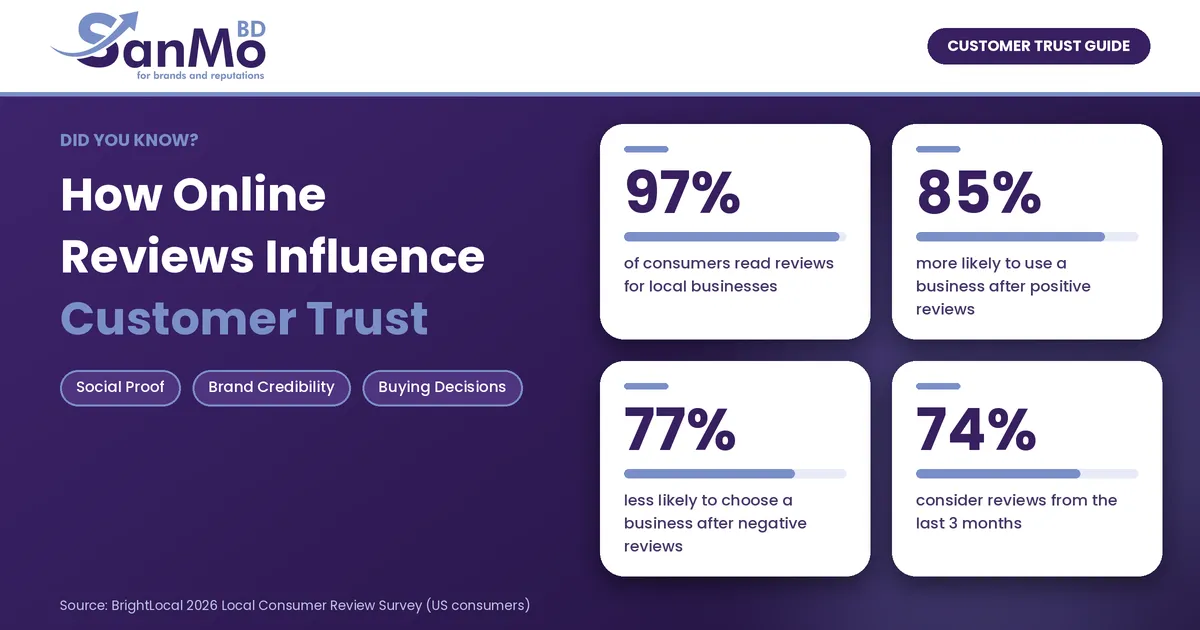
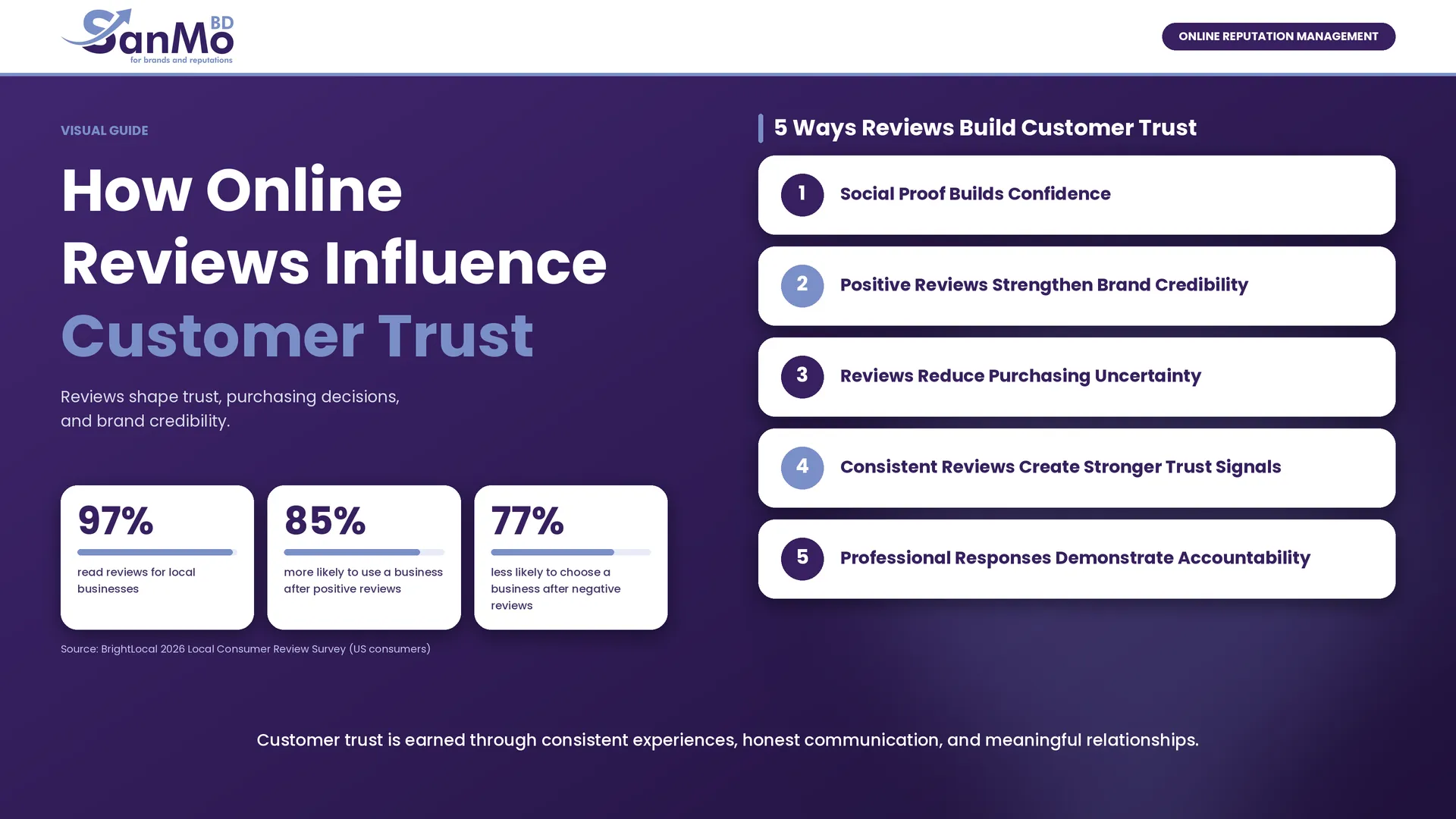
According to BrightLocal’s 2026 Local Consumer Review Survey, 97% of surveyed consumers read reviews for local businesses. The research also found that 85% are more likely to use a business after reading positive reviews, while 77% are less likely to choose a business after reading negative reviews.
These statistics demonstrate how strongly customer feedback can influence business perception. However, the survey represents US consumers, so the percentages should not automatically be treated as representative of Bangladesh or every other market.
For businesses operating in competitive markets, understanding how online reviews influence customer trust can help improve customer relationships, strengthen brand credibility, and support long-term growth.
1. What Are Online Reviews and Why Are They Important?
Online reviews are publicly shared opinions, ratings, and experiences from customers who have purchased a product, used a service, or interacted with a business.
They help potential customers understand what they can expect before making a purchasing decision.
Online reviews commonly appear on:
- Google Business Profile
- Facebook business pages
- Trustpilot
- Yelp
- Amazon
- Tripadvisor
- Industry-specific review websites
- Business websites and eCommerce platforms
Reviews can contain star ratings, written comments, customer photographs, videos, and detailed descriptions of individual experiences.
For example, someone looking for a digital marketing agency may compare several companies before choosing one. Instead of relying entirely on promotional advertisements, that person may examine previous customers’ feedback about communication, service quality, project delivery, and customer support.
This makes online reviews valuable because they provide additional information beyond a company’s own marketing messages.
Why Do Customers Read Online Reviews?
Customers generally read reviews for several reasons:
- To understand product and service quality.
- To evaluate whether a company is reliable.
- To compare different businesses.
- To identify potential problems.
- To learn about previous customer experiences.
- To reduce the risk of making an unsuitable purchase.
- To understand how a business handles customer complaints.
In simple terms, reviews help customers make more informed decisions.
2. How Online Reviews Influence Customer Trust
Online reviews influence customer trust through several psychological and practical factors. They provide social proof, demonstrate customer satisfaction, reveal business transparency, and help potential buyers evaluate purchasing risks.
Understanding these factors helps businesses develop better customer experience and reputation management strategies.
2.1 Social Proof Builds Customer Confidence
Social proof is a psychological principle in which people observe the decisions and experiences of others when making their own choices.
When potential customers see that other people have purchased from a company and shared positive experiences, they may feel more comfortable choosing that business.
Consider two online stores selling similar products at comparable prices.
Store A:
- Very few customer reviews.
- Limited information about customer experiences.
- No visible responses to customer questions.
Store B:
- Multiple authentic customer reviews.
- Detailed feedback about product quality.
- Professional responses to customer questions.
A potential customer may feel more confident purchasing from Store B because other customers have already shared their experiences.
This does not mean that more reviews automatically guarantee better service. However, authentic and consistent customer feedback can reduce uncertainty.
Social proof is particularly important for new businesses that have not yet established strong brand recognition.
2.2 Positive Reviews Strengthen Brand Credibility
Brand credibility refers to how believable, dependable, and trustworthy a company appears to its target audience.
Positive customer reviews can strengthen credibility by demonstrating that a business has successfully served real customers.
For example, a software development company may describe its technical expertise on its website. However, when previous customers share detailed feedback about completed projects, communication quality, deadlines, and technical support, potential clients receive additional reasons to consider that company.
Credibility becomes stronger when reviews:
- Describe specific customer experiences.
- Include relevant details about the service.
- Appear consistently over time.
- Come from authentic customers.
- Reflect the actual products or services offered.
Generic comments such as “Excellent service” can create a positive impression, but detailed reviews usually provide more useful information.
2.3 Reviews Reduce Purchasing Uncertainty
Customers often hesitate before purchasing something they have not experienced.
This uncertainty is particularly common when purchasing expensive products, hiring professional services, or choosing an unfamiliar company.
Reviews help reduce uncertainty by providing information about what customers can realistically expect.
For example, someone planning to hire a digital marketing agency may want to know:
- Does the agency communicate professionally?
- Does it understand business requirements?
- Does it deliver work on time?
- Are its services worth the investment?
- Does it provide ongoing support?
Previous customer experiences can help answer these questions.
As a result, reviews become an important information source during the customer decision-making process.
2.4 Consistent Reviews Create Stronger Trust Signals
A single positive review may create a good first impression, but customers often look for patterns across multiple reviews.
If different customers consistently mention reliable service, helpful communication, and good product quality, these repeated experiences can strengthen confidence.
Consistency matters because customers are not simply looking for the highest rating. They also want evidence that a business delivers dependable experiences over time.
BrightLocal’s 2026 research identifies consistent sentiment across multiple reviews as the most important review-related factor among the options presented to survey respondents.
For companies, this means maintaining customer satisfaction should be a continuous priority rather than a short-term review collection campaign.
2.5 Professional Responses Demonstrate Accountability
Customer trust is influenced not only by what people write about a business but also by how the business responds.
When a company acknowledges feedback, answers questions, and addresses complaints professionally, it demonstrates accountability.
For example, a customer leaves a negative review explaining that an order arrived late.
An unprofessional response might blame the customer or ignore the complaint.
A better response would acknowledge the inconvenience, apologize where appropriate, investigate the issue, and explain how the company intends to resolve it.
Other potential customers can observe this interaction.
Even when a business receives criticism, its response can demonstrate that customer concerns are taken seriously.
3. How Negative Reviews Affect Customer Trust
Negative reviews can influence purchasing decisions because they reveal potential problems that customers may want to avoid.
However, receiving a negative review does not automatically mean a business has lost customer trust.
The way a company handles criticism can influence its reputation.
3.1 Negative Reviews Can Create Doubt
When customers repeatedly encounter complaints about poor service, product quality, delayed delivery, or unresponsive support, they may question whether the business is reliable.
For example, an online retailer receiving repeated complaints about incorrect products may discourage new customers from purchasing.
The issue becomes more serious when similar complaints appear across multiple platforms.
Businesses should investigate recurring complaints instead of treating every negative review as an isolated incident.
3.2 Negative Feedback Can Reveal Business Problems
Not every negative review is harmful information.
Sometimes, customer complaints reveal problems that businesses have not identified internally.
Examples include:
- Slow customer support.
- Complicated ordering processes.
- Unclear pricing.
- Product quality issues.
- Poor communication.
- Delivery delays.
- Inconsistent service quality.
These insights can help businesses identify weaknesses and improve customer experiences.
A company that listens to criticism and takes meaningful action can use negative feedback as an opportunity for improvement.
3.3 Ignoring Negative Reviews Can Damage Credibility
Customers may become concerned when businesses consistently ignore complaints.
Silence can create the impression that a company does not care about customer satisfaction.
Professional review management should therefore include monitoring feedback and responding appropriately.
Businesses do not need to argue with every reviewer. Instead, they should focus on understanding the issue, communicating respectfully, and providing practical solutions.
3.4 A Balanced Review Profile Looks More Authentic
An online profile containing only perfect ratings and identical comments may appear less convincing to some consumers.
Real businesses serve different customers with different expectations. Consequently, occasional criticism is possible.
A balanced collection of genuine reviews can provide a more realistic picture of a company’s strengths and weaknesses.
The goal should not be to eliminate all negative feedback. The goal should be to deliver better experiences and handle problems responsibly.
4. The Role of Star Ratings in Customer Decision-Making
Star ratings provide a quick way for customers to compare businesses.
A five-star rating can create an immediate positive impression, while a low rating may encourage someone to investigate further.
However, star ratings should not be evaluated independently.
Consider these two examples:
| Business | Rating | Number of Reviews |
|---|---|---|
| Business A | 5.0 | 3 |
| Business B | 4.7 | 250 |
Some customers may prefer Business B because its rating is supported by a larger collection of customer experiences.
Others may investigate Business A further because it has fewer reviews.
Important factors include:
- Average star rating.
- Total number of reviews.
- Review recency.
- Detailed customer experiences.
- Consistency of feedback.
- Business responses.
Does a Higher Star Rating Always Mean More Trust?
No. A higher star rating does not automatically mean that a business is more trustworthy.
Customers may also examine whether reviews are genuine, relevant, recent, and consistent.
For example, a company with a 4.8-star rating and detailed customer feedback may appear more credible than one with a perfect rating but very little supporting information.
Businesses should focus on delivering quality experiences rather than chasing perfect ratings.
5. Why Recent Customer Reviews Matter
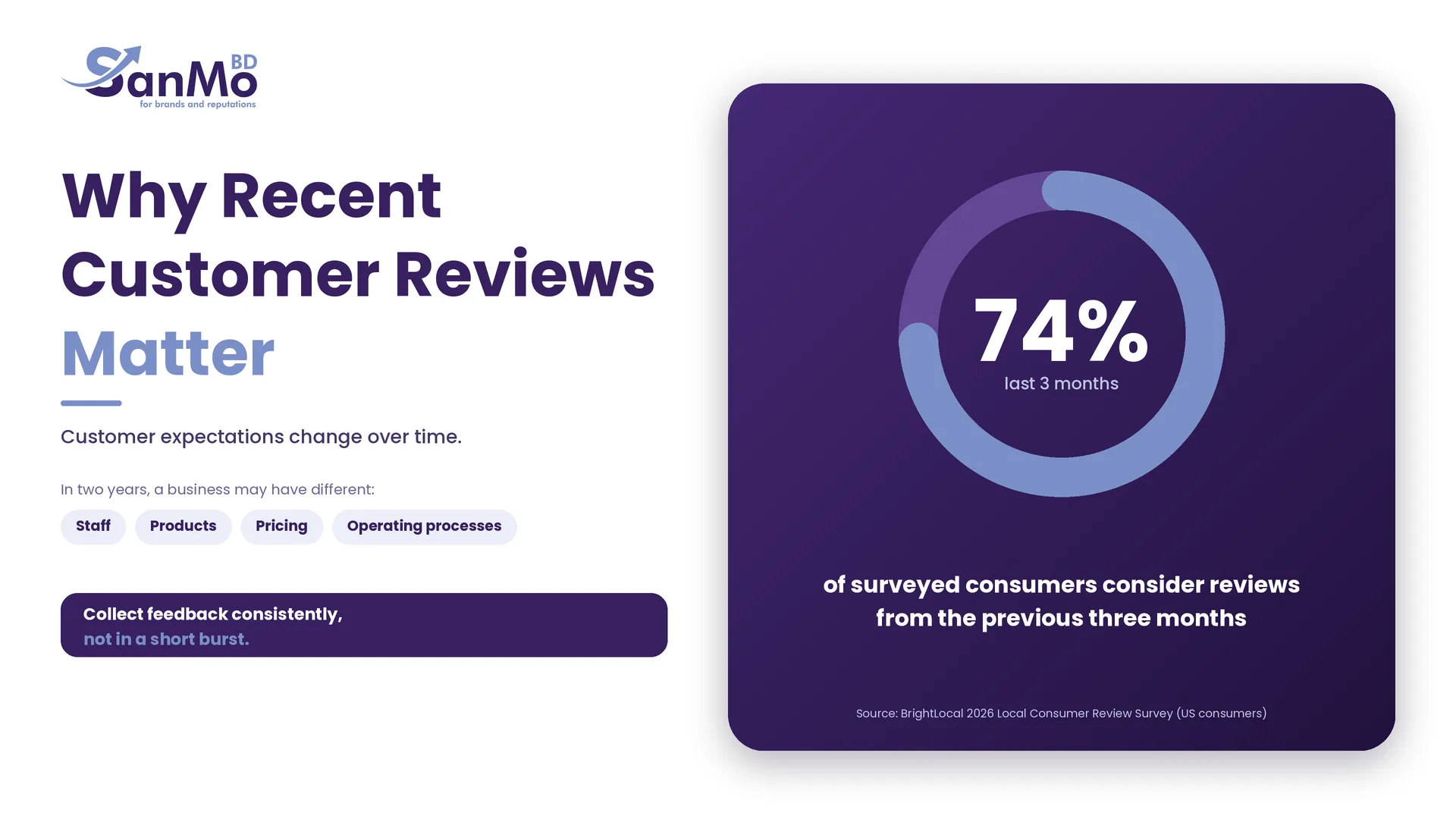
Customer expectations change over time. A business that provided excellent service two years ago may have different staff, products, pricing, or operating processes today.
This is why review recency matters.
BrightLocal’s 2026 survey found that 74% of surveyed consumers consider reviews from the previous three months when evaluating businesses.
Recent feedback helps customers understand whether a company is still delivering satisfactory experiences.
For businesses, this highlights the importance of collecting feedback consistently.
Instead of focusing on receiving a large number of reviews within a short period, companies should develop a sustainable process that encourages customers to share genuine experiences after receiving a product or service.
A consistent review history can demonstrate that a business remains active and attentive to its customers.
6. How Online Reviews Influence Purchasing Decisions
Customer trust and purchasing behavior are closely connected. Understanding how online reviews influence customer trust helps businesses see why customer feedback can affect decisions throughout the buying journey.
When customers trust a business, they may feel more comfortable contacting it, requesting a quotation, booking a service, or completing a purchase.
Online reviews can influence different stages of the buying journey.
Stage 1: Business Discovery
A customer discovers a business through search engines, social media, advertisements, or recommendations.
At this stage, reviews can influence whether the customer considers the company a potential option.
Stage 2: Research and Comparison
The customer compares available businesses by examining ratings, written reviews, service descriptions, pricing, and other customers’ experiences.
Stage 3: Trust Evaluation
The customer evaluates whether the business appears dependable. Recent reviews, professional responses, and consistent feedback can demonstrate how online reviews influence customer trust and strengthen confidence in the business.
Stage 4: Purchase Decision
After gathering sufficient information, the customer decides whether to purchase, contact the business, or continue researching. Positive and credible reviews may help reduce uncertainty and encourage action.
Stage 5: Post-Purchase Experience
After receiving the product or service, the customer may share feedback about their experience. That feedback becomes useful information for future buyers.
This creates an ongoing cycle in which customer experiences influence future purchasing decisions and help shape a business’s online reputation.
7. The Importance of Online Reviews for Local Businesses in Bangladesh
Online reviews are especially valuable for local businesses because customers often need reassurance before visiting an unfamiliar location or purchasing from a local service provider.
In Bangladesh, customers frequently discover businesses through Google Search, Google Maps, Facebook, and other digital platforms.
For example, someone searching for a restaurant in Dhaka may compare customer ratings, photographs, location information, and written feedback before deciding where to eat.
Similarly, someone looking for an IT company, marketing agency, or professional service provider may investigate the company’s online reputation before making contact.
Why Reviews Matter for Bangladeshi Businesses
1. Building Local Credibility
Reviews help local businesses demonstrate their customer experience to people searching within a particular area.
2. Increasing Customer Confidence
Authentic feedback can reduce hesitation among customers who have never interacted with a business.
3. Supporting Local Search Visibility
Reviews and customer reputation contribute to the broader local search experience. They help prospective customers evaluate businesses appearing in local search results.
Google explains that local search results are mainly determined by relevance, distance, and prominence. Its official guidance also identifies review quantity and positive ratings as factors that can contribute to prominence.
Businesses can learn more through Google’s official guide to improving local ranking on Google.
However, reviews alone do not guarantee higher rankings.
4. Improving Business Reputation
Consistent feedback and professional communication can strengthen how customers perceive a company.
5. Understanding Customer Expectations
Reviews provide useful information about what customers appreciate and what they want businesses to improve.
For Bangladeshi startups and small businesses, developing a reliable review management strategy can become an important part of long-term digital growth.
8. How Google Reviews Influence Customer Trust
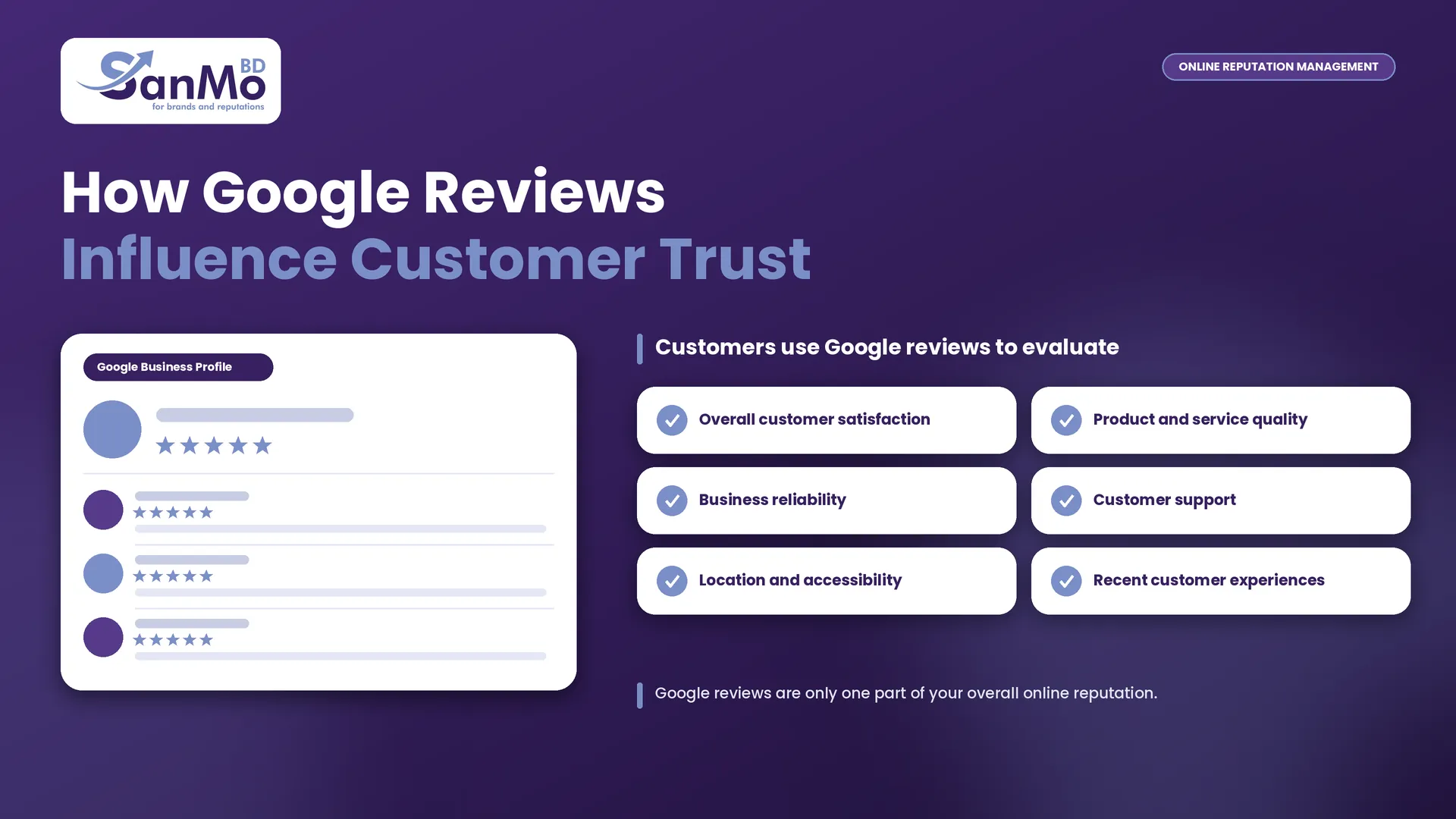
Google Reviews are among the most visible customer feedback sources for businesses with a Google Business Profile.
When people search for a local company, they may encounter its business profile alongside ratings, customer comments, photographs, and other information.
This visibility makes Google Reviews particularly important for local businesses.
Customers often use Google reviews to evaluate:
- Overall customer satisfaction.
- Product and service quality.
- Business reliability.
- Customer support.
- Location and accessibility.
- Recent customer experiences.
For example, someone searching for a web development company in Dhaka may compare different companies through their Google Business Profiles before visiting their websites.
A company with accurate information, genuine reviews, and professional responses may create a stronger first impression.
However, businesses should remember that Google reviews are only one part of their overall online reputation.
Maintaining accurate business information, updating the website, responding to customers, and providing consistent service are equally important.
Businesses should also follow Google’s policies and avoid buying reviews, creating fake feedback, or manipulating ratings.
9. How to Build Customer Trust Through Online Reviews
Developing customer trust requires a consistent strategy.
Businesses should focus on collecting genuine feedback, improving customer experiences, and communicating transparently.
Here are practical strategies companies can implement.
9.1 Deliver Excellent Customer Experiences
The foundation of positive reviews is customer satisfaction.
Businesses should prioritize product quality, service reliability, communication, and after-sales support.
A company cannot build sustainable trust simply by requesting positive reviews.
It must first provide experiences worth recommending.
9.2 Make It Easy for Customers to Leave Reviews
Customers may be willing to share feedback but forget to do so after completing a purchase.
Businesses can simplify the process by sharing review links through:
- Follow-up emails.
- WhatsApp messages.
- SMS notifications.
- Order confirmation messages.
- Website thank-you pages.
- Social media communication.
The request should be polite and should not pressure customers to provide positive feedback.
9.3 Respond to Positive and Negative Reviews
Every review represents an opportunity to communicate with customers.
For positive reviews, businesses can express appreciation and acknowledge specific feedback.
For negative reviews, they should remain professional, understand the problem, and suggest a suitable resolution.
Responses should sound natural rather than copied from a generic template.
9.4 Maintain Consistent Business Information
Customers may become uncertain if different platforms display different business names, contact numbers, addresses, or service information.
Businesses should maintain accurate and consistent information across their websites, social media accounts, and business directories.
Consistency supports a more reliable online identity.
9.5 Monitor Reviews Across Multiple Platforms
Customer feedback does not appear on Google alone.
Businesses should monitor relevant platforms where their customers discuss products, services, and experiences.
Regular monitoring helps companies identify potential reputation issues before they become larger problems.
9.6 Learn From Customer Feedback
Review management should not stop after responding to comments.
Businesses should identify recurring issues and use feedback to improve internal processes.
For example, if several customers mention slow responses, the business may need to improve its support system.
This approach turns customer feedback into practical business intelligence.
9.7 Avoid Fake Reviews and Manipulated Ratings
Fake reviews can damage customer confidence and create serious reputational risks.
Businesses should never purchase fabricated testimonials, create false customer accounts, or pressure customers to leave five-star ratings.
The US Federal Trade Commission has introduced a rule addressing deceptive review practices, including fake reviews and certain manipulative incentives. Businesses can consult its official Consumer Reviews and Testimonials Rule.
Although specific legal requirements differ by country, authenticity and transparency should remain fundamental principles for every business.
10. The Connection Between Online Reviews, SEO, and GEO
Online reviews are not only important for customer relationships. They also connect with broader digital marketing and search visibility strategies.
Online Reviews and SEO
Search engine optimization helps businesses become discoverable when customers search for relevant products and services.
Customer reviews contribute to the information available about a business, especially in local search environments.
A strong SEO strategy should work alongside:
- Accurate business information.
- High-quality website content.
- Relevant local landing pages.
- Google Business Profile optimization.
- Genuine customer feedback.
- Consistent brand information.
- A positive customer experience.
Businesses should not assume that collecting more reviews automatically guarantees higher organic rankings.
Google uses multiple ranking systems and signals, and reviews are only one part of the wider search ecosystem.
Online Reviews and GEO (Generative Engine Optimization)
Generative Engine Optimization focuses on making business information clear, credible, and useful for AI-powered search and answer experiences.
As customers increasingly use AI assistants to research products and services, consistent information about businesses becomes more important.
For example, someone might ask an AI assistant:
“Which digital marketing agencies in Bangladesh offer reliable services?”
To understand and describe businesses accurately, AI-powered systems may use information from websites, public sources, business profiles, and other available content.
Authentic customer feedback can provide additional context about customer experiences.
Businesses can support their GEO strategy by:
- Maintaining accurate business information.
- Publishing helpful and informative website content.
- Using consistent brand names across platforms.
- Providing clear service descriptions.
- Building a credible online reputation.
- Encouraging authentic customer feedback.
- Answering common customer questions.
- Maintaining trustworthy and relevant external mentions.
Reviews do not guarantee that an AI assistant will recommend a particular company. However, a consistent and credible digital presence can help establish a stronger foundation for online discovery.
11. Common Online Review Management Mistakes Businesses Should Avoid
Even businesses with good products and services can damage customer trust through poor review management.
Here are some common mistakes.
Ignoring negative feedback: Leaving customer complaints unanswered can make a business appear unresponsive.
Buying fake reviews: Artificial ratings undermine authenticity and can create platform and regulatory risks.
Asking only for positive reviews: Selectively collecting favorable feedback creates a misleading picture of customer satisfaction.
Using identical responses: Repeated generic replies may make customers feel that their feedback is not being taken seriously.
Focusing only on star ratings: A high rating cannot replace excellent customer experiences.
Neglecting older customer feedback: Previous reviews may reveal unresolved issues that still affect customer perceptions.
Failing to monitor multiple platforms: Important customer conversations may happen outside Google.
Making unrealistic promises: Businesses should never promise results or solutions they cannot deliver.
Avoiding these mistakes helps companies develop a more transparent and sustainable reputation management approach.
12. How SanMo Bangladesh Helps Businesses Build Online Trust
Building customer trust requires more than collecting positive reviews. Businesses need a complete approach that combines customer feedback, reputation monitoring, communication, and digital visibility.
SanMo Bangladesh focuses on helping businesses strengthen their digital presence and manage how their brands are perceived online.
Through its reputation-focused solutions, SanMo Bangladesh supports businesses in developing a stronger and more credible online identity.
Its approach connects several important areas.
Online Reputation Management
Businesses need to understand what customers are saying about them across digital platforms.
Online reputation management helps monitor brand mentions, identify potential reputation risks, and improve how a business is represented online.
A structured approach also helps businesses identify recurring customer concerns and develop appropriate responses.
Review Management and Response Strategy
Customer reviews require consistent attention.
A structured review management strategy helps businesses monitor feedback, respond professionally, and encourage authentic customer experiences to be shared.
Reputation Monitoring
Regular monitoring helps businesses identify negative mentions, customer complaints, and potential reputation issues.
Early awareness allows companies to respond more effectively.
SEO and Digital Visibility
A trustworthy online presence also depends on how easily customers can discover accurate business information.
SEO-focused content, relevant website pages, and consistent brand information can support long-term digital visibility.
Businesses interested in strengthening their online credibility can explore SanMo Bangladesh’s reputation management solutions to understand how review management, brand monitoring, and reputation-focused strategies can support their digital presence.
The objective is simple: help businesses establish a reliable digital presence, strengthen customer confidence, and build lasting relationships.
13. How to Measure the Impact of Online Reviews on Customer Trust
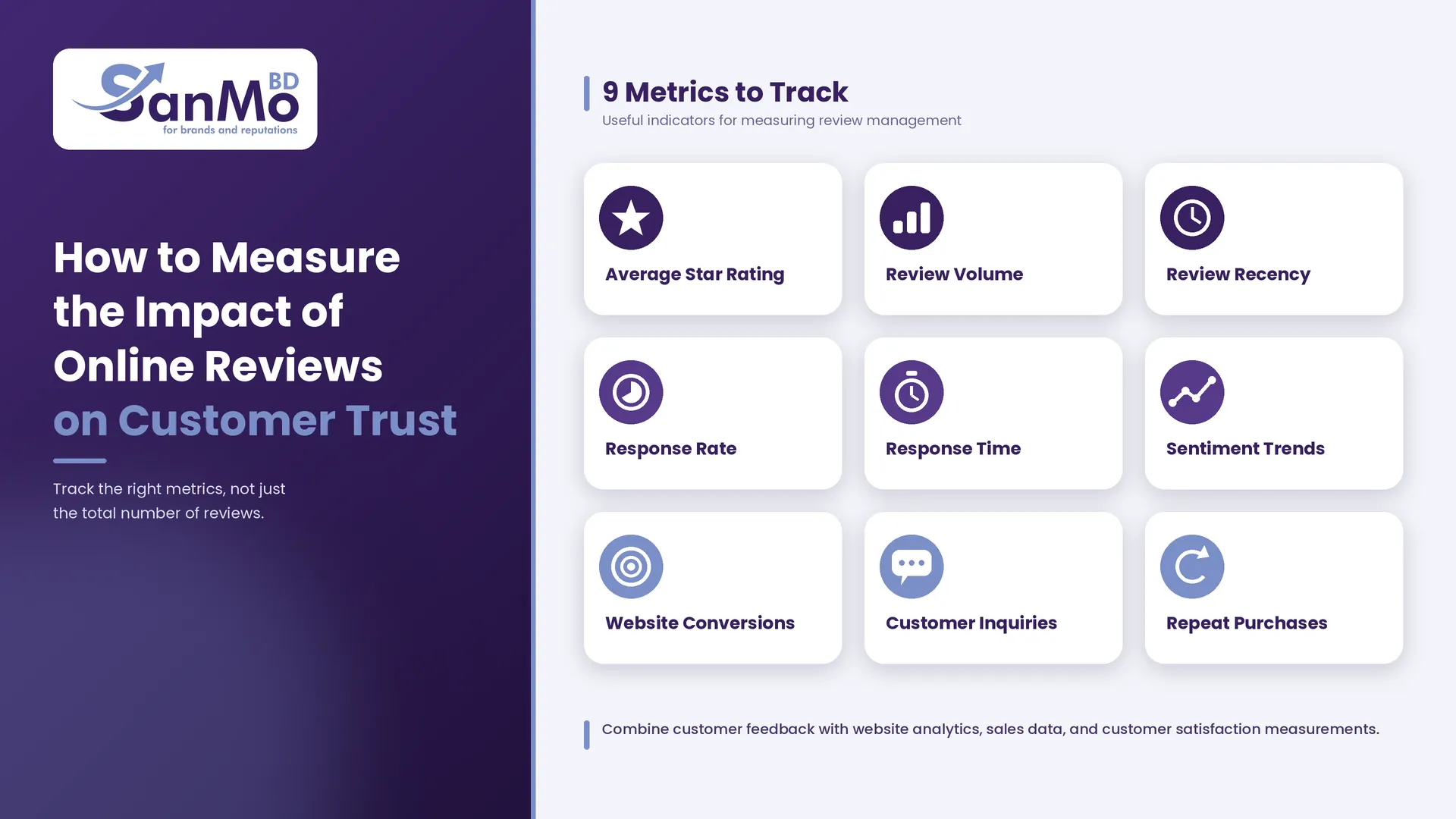
Businesses should evaluate review management using measurable indicators rather than focusing exclusively on the total number of reviews.
Some useful performance indicators include:
| Metric | What It Measures |
|---|---|
| Average star rating | Overall customer rating |
| Review volume | Number of customer reviews |
| Review recency | How recently customers shared feedback |
| Response rate | Percentage of reviews receiving responses |
| Response time | How quickly the business responds |
| Sentiment trends | Positive, negative, and neutral feedback patterns |
| Website conversions | Visitors completing desired actions |
| Customer inquiries | Leads generated through digital channels |
| Repeat purchases | Customers returning for additional purchases |
These metrics help businesses understand whether their reputation management activities are improving customer engagement and supporting business growth.
For example, a company may receive more website inquiries after improving its customer communication and online reputation.
However, businesses should analyze multiple data sources before concluding that reviews alone caused an increase in conversions.
The strongest approach combines customer feedback with website analytics, sales data, and customer satisfaction measurements.
14. The Future of Online Reviews and Customer Trust
The way customers discover and evaluate businesses continues to evolve.
Traditional written reviews remain important, but customers increasingly interact with different forms of digital content.
These include:
- Video testimonials.
- Customer photographs.
- Social media discussions.
- Expert comparisons.
- Community recommendations.
- AI-powered business recommendations.
- Detailed product and service experiences.
BrightLocal’s 2026 research highlights the growing role of AI tools in local business discovery.
This development means businesses should think beyond collecting reviews on a single platform.
They should focus on building a consistent reputation across their digital presence.
Authenticity, transparency, customer experience, and reliable information will remain important as search and discovery technologies continue to develop.
Companies that invest in these areas can establish stronger relationships with existing customers while creating greater confidence among potential buyers.
Conclusion
Online reviews play a significant role in shaping customer trust, influencing purchasing decisions, and strengthening brand reputation.
Customers use reviews to understand real experiences, compare businesses, evaluate reliability, and reduce the uncertainty associated with purchasing decisions.
Positive reviews can strengthen credibility, while negative feedback can reveal weaknesses that businesses need to address. More importantly, professional responses to customer feedback demonstrate accountability and a commitment to improvement.
For businesses in Bangladesh and international markets, maintaining a trustworthy online reputation requires continuous effort. Companies should encourage authentic reviews, respond professionally, monitor customer feedback, maintain accurate business information, and consistently improve their products and services.
Online reviews should never be treated as just another marketing metric. They represent customer experiences and influence how future customers perceive a brand.
SanMo Bangladesh believes that a strong digital presence begins with credibility, transparency, and trust. By combining online reputation management, review monitoring, and digital marketing strategies, businesses can create a stronger foundation for sustainable growth.
Ultimately, customer trust is not built through ratings alone. It is earned through consistent experiences, honest communication, and meaningful relationships.
Frequently Asked Questions (FAQs)
1. How Do Online Reviews Influence Customer Trust?
Online reviews influence customer trust by sharing genuine experiences and building business credibility.
2. Why Are Online Reviews Important for Businesses?
They improve brand reputation, influence buying decisions, and strengthen customer confidence.
3. Do Positive Reviews Increase Customer Trust?
Yes. Positive customer reviews encourage potential customers to trust a business.
4. Can Negative Reviews Damage Brand Reputation?
Yes. Negative reviews can reduce customer trust if businesses ignore customer concerns.
5. How Many Online Reviews Does a Business Need?
There is no fixed number. Authentic and consistent reviews matter most.
6. Do Recent Customer Reviews Matter?
Yes. Recent reviews help customers understand a business’s current service quality.
7. How Should Businesses Manage Negative Reviews?
Businesses should respond politely, acknowledge complaints, and offer practical solutions.
8. Do Online Reviews Help Local SEO?
Yes. Customer reviews support local SEO and improve business visibility in local searches.
9. Why Are Fake Reviews Harmful?
Fake reviews damage credibility and negatively affect customer trust.
10. How Do Online Reviews Influence Customer Trust and Buying Decisions?
They build credibility, reduce uncertainty, and help customers make informed purchasing decisions.