Online Reputation Management (ORM) is the process of monitoring, managing, and improving how customers, search engines, and AI-powered platforms perceive a business online. From Google reviews and social media comments to search engine results and online news, every digital interaction can influence customer trust. Effective online reputation management helps businesses address negative feedback, strengthen brand credibility, improve online visibility, and build long-term customer relationships. This guide explains how ORM works, why it matters, how AI is transforming reputation management, and how businesses can develop a practical reputation management strategy with support from SanMo Bangladesh.
What Is Online Reputation Management?
Online Reputation Management (ORM) refers to the strategies and activities used to monitor, influence, and improve the public perception of a business, brand, product, or individual on the internet.
When potential customers discover a company, they often research its website, read customer reviews, check social media profiles, and search for independent feedback before making a decision. The information they find can determine whether they trust the business enough to contact it or purchase its products and services.
Online reputation management helps businesses understand these perceptions and respond strategically.
For example, a restaurant may receive negative feedback about its service, while an e-commerce business may face complaints about delivery delays. A professional service provider may discover outdated information appearing in search results. In each situation, reputation management involves identifying the problem, communicating transparently, correcting issues where possible, and building a stronger digital presence.
Effective ORM typically includes:
- Monitoring online mentions and brand conversations.
- Managing customer reviews across relevant platforms.
- Responding professionally to positive and negative feedback.
- Publishing accurate, useful, and trustworthy content.
- Improving the visibility of official brand information.
- Identifying potential reputation threats before they escalate.
- Measuring customer sentiment and reputation-related performance.
Unlike a one-time marketing campaign, online reputation management is an ongoing process. It requires consistent monitoring, customer communication, and continuous improvement.
Businesses can explore SanMo Bangladesh’s Reputation Management Services to understand how structured reputation management can support their digital presence.
Why Is Online Reputation Management Important for Businesses?
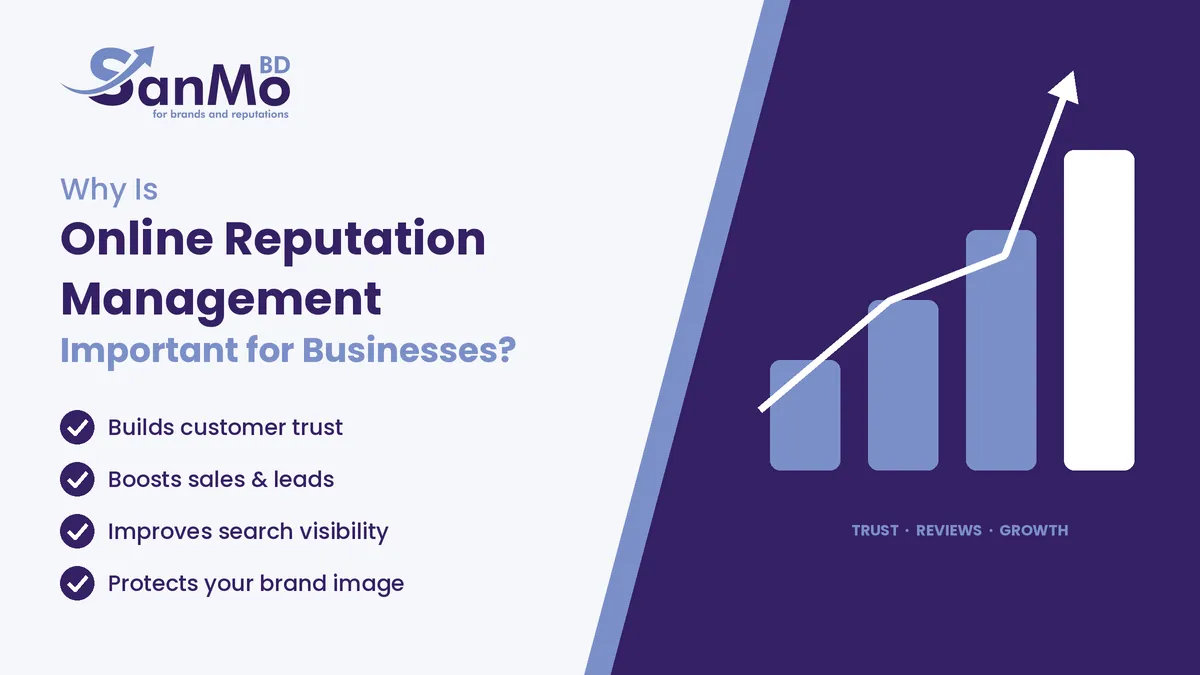
A company’s reputation influences how people evaluate its reliability, service quality, and professionalism. Even a business with excellent products can struggle if potential customers encounter unanswered complaints, inconsistent information, or repeated negative reviews.
Here are the main reasons online reputation management matters.
1. Builds Customer Trust and Credibility
Trust is essential to customer relationships. People are more likely to consider a business when they can find clear information, authentic reviews, and professional responses to customer questions.
A well-managed online presence helps demonstrate that a company values its customers and takes responsibility for its services.
However, credibility cannot be built through positive content alone. Customers also notice how a business responds when something goes wrong. A thoughtful response to a genuine complaint can demonstrate accountability and a willingness to improve.
2. Influences Purchasing Decisions
Customers often compare several businesses before choosing one. Reviews, ratings, testimonials, and publicly available information can influence which company they contact.
For example, two businesses may offer similar services at comparable prices. If one provides accurate information and responds constructively to customer feedback while the other ignores complaints, potential customers may feel more confident choosing the first business.
Online reputation management helps companies identify the factors influencing these decisions and improve the overall customer experience.
3. Supports Search Visibility and SEO
Search engine optimization and reputation management are closely related, although they serve different purposes.
SEO helps relevant pages become more discoverable in search results. Reputation management focuses on the accuracy, quality, and perception of the information people encounter about a brand.
Useful content, accurate business information, a well-maintained website, and positive customer experiences can support a stronger online presence. Reviews may also influence how people interact with local business listings.
However, reputation management does not guarantee higher rankings. Search engines use multiple ranking signals, and reviews alone do not determine organic search performance.
Businesses can combine reputation management with SEO Services to strengthen their overall digital marketing strategy.
4. Helps Protect Brand Credibility
Negative reviews, misinformation, outdated articles, and unresolved customer complaints can affect public perception. If these issues remain unaddressed, they may become more visible and influence future customer decisions.
A proactive ORM strategy helps businesses identify emerging issues, investigate their causes, and take appropriate action.
The objective is not to hide every criticism. It is to ensure that information about the business is accurate, that genuine customer concerns receive attention, and that misleading content is addressed through legitimate channels.
5. Strengthens Customer Relationships
Reputation management creates opportunities to understand customers better.
When businesses review complaints and feedback regularly, they can identify recurring service problems, improve internal processes, and develop more customer-focused policies.
This makes ORM valuable beyond marketing. It can support customer service, product development, operational improvements, and long-term customer retention.
How Does Online Reputation Management Work?
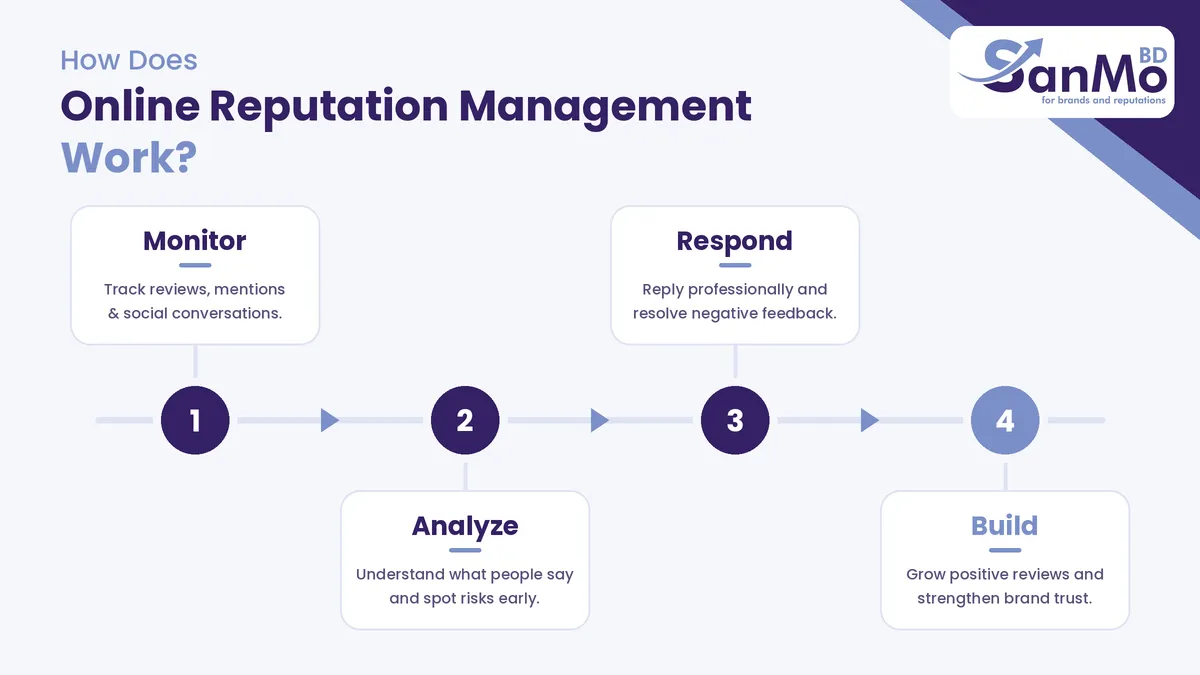
A successful online reputation management strategy follows a structured process. The exact approach depends on the company’s industry, audience, existing reputation, and business objectives.
Step 1: Audit Your Current Online Reputation
Start by understanding what people currently see when they search for your business.
Search your company name, brand variations, products, services, and relevant branded keywords. Review your website, business listings, social media profiles, customer reviews, news coverage, and other relevant search results.
Look for:
- Inaccurate contact details or business descriptions.
- Unanswered customer complaints.
- Repeated negative feedback about the same issue.
- Outdated or misleading information.
- Inconsistent branding across platforms.
- Missing official profiles or important business information.
Record the findings and prioritize issues according to their potential impact.
Step 2: Monitor Brand Mentions and Customer Feedback
Monitoring helps businesses discover what customers and other online audiences are saying.
Relevant sources may include Google Business Profile, Facebook, industry review websites, discussion forums, blogs, news publications, and social media platforms.
The most useful monitoring system tracks more than negative comments. It also identifies recurring questions, positive customer experiences, product concerns, and emerging conversations.
Businesses can use monitoring tools, platform notifications, manual searches, and AI-assisted analysis to organize this information.
Step 3: Respond to Reviews Professionally
Review management is one of the most visible parts of online reputation management.
A strong response should acknowledge the customer’s experience, address the concern, and explain the next step when appropriate.
For negative reviews, avoid defensive language or public arguments. If the issue involves private information, move the conversation to a secure communication channel.
For positive reviews, a genuine thank-you can help reinforce the customer relationship.
Businesses should also request honest feedback from customers without offering incentives in exchange for positive reviews or attempting to manipulate ratings.
Learn more about Review Management and Response Strategy.
Step 4: Improve Your Digital Presence
A strong digital presence makes it easier for people to find reliable information about a company.
Keep your official website, service pages, social profiles, business listings, and contact details accurate and consistent. Publish useful content that answers customer questions and explains your expertise.
For local businesses, accurate business information is particularly important because potential customers may be searching for opening hours, location, service availability, or contact details.
Your website should also provide a clear explanation of what the company offers and how customers can get in touch.
Step 5: Address Harmful or Misleading Content
Not every negative result is inaccurate, and not every critical review should be removed.
First, determine whether the content is genuine criticism, a factual error, a policy violation, impersonation, or potentially defamatory material.
Depending on the situation, appropriate actions may include contacting the publisher, requesting a factual correction, reporting a policy violation, seeking legal advice, or publishing accurate information that provides additional context.
When removal is not possible, legitimate SEO and content strategies may help relevant, accurate information become more visible over time.
Step 6: Measure Results and Improve Continuously
Reputation management should be evaluated using meaningful performance indicators.
Useful metrics include review response time, review volume, average rating trends, recurring complaint categories, brand mention sentiment, branded search visibility, website engagement, and leads generated from reputation-related channels.
Establish a baseline before implementing changes. Then compare results over time and adjust the strategy based on what the data reveals.
How AI Is Transforming Online Reputation Management
Artificial intelligence is changing how businesses collect, analyze, and respond to online feedback. AI-powered systems can help organize large volumes of information, identify patterns, and support faster decision-making.
However, AI works best when combined with human judgment, reliable data, and clear communication standards.
1. AI-Powered Sentiment Analysis
Sentiment analysis uses natural language processing to classify text according to its expressed tone or opinion.
For example, an AI tool may analyze customer comments to identify recurring concerns about delivery, pricing, service quality, or product performance.
This helps businesses understand broad patterns without manually reviewing every comment individually.
Sentiment analysis is not perfect. Sarcasm, local expressions, mixed-language comments, and cultural context can lead to incorrect classifications. Important findings should be checked by a human reviewer.
2. Automated Brand Monitoring
AI-assisted monitoring can help organize brand mentions across supported websites, social channels, and other sources.
Depending on the tools and integrations available, businesses may receive alerts about unusual increases in negative mentions, repeated complaints, or emerging discussions.
Earlier awareness can give teams more time to investigate issues and prepare an appropriate response.
3. AI-Assisted Review Responses
AI can help draft responses to customer reviews by identifying the main concern and suggesting professional language.
For example, a tool can prepare a draft acknowledging a delivery delay and explaining how the customer can contact support.
However, businesses should review every response before publishing it. Automated replies should not invent facts, promise compensation without approval, disclose personal information, or sound insensitive to a customer’s experience.
4. AI for Reputation Risk Detection
AI systems can help identify unusual patterns, including sudden increases in complaints or repeated mentions of a potential service problem.
These signals may help a business investigate a developing issue before it grows.
Nevertheless, a sudden increase in negative mentions does not automatically indicate a coordinated attack or a reputation crisis. Teams must verify the context and distinguish genuine customer feedback from spam, irrelevant discussion, and other noise.
5. Generative AI and Search Reputation
Generative AI platforms can summarize information about companies using available sources. Customers may increasingly use AI-powered search experiences to discover businesses, compare providers, and ask questions about services.
This creates an additional reason to maintain accurate, consistent, and useful information across official websites and reputable third-party sources.
Businesses should publish clear service descriptions, answer common questions, maintain accurate business details, and demonstrate expertise through genuinely useful content.
No business can guarantee that an AI platform will mention it, recommend it, or produce a particular description. The practical goal is to make reliable information accessible and understandable.
Online Reputation Management for AI Search, AEO, and GEO
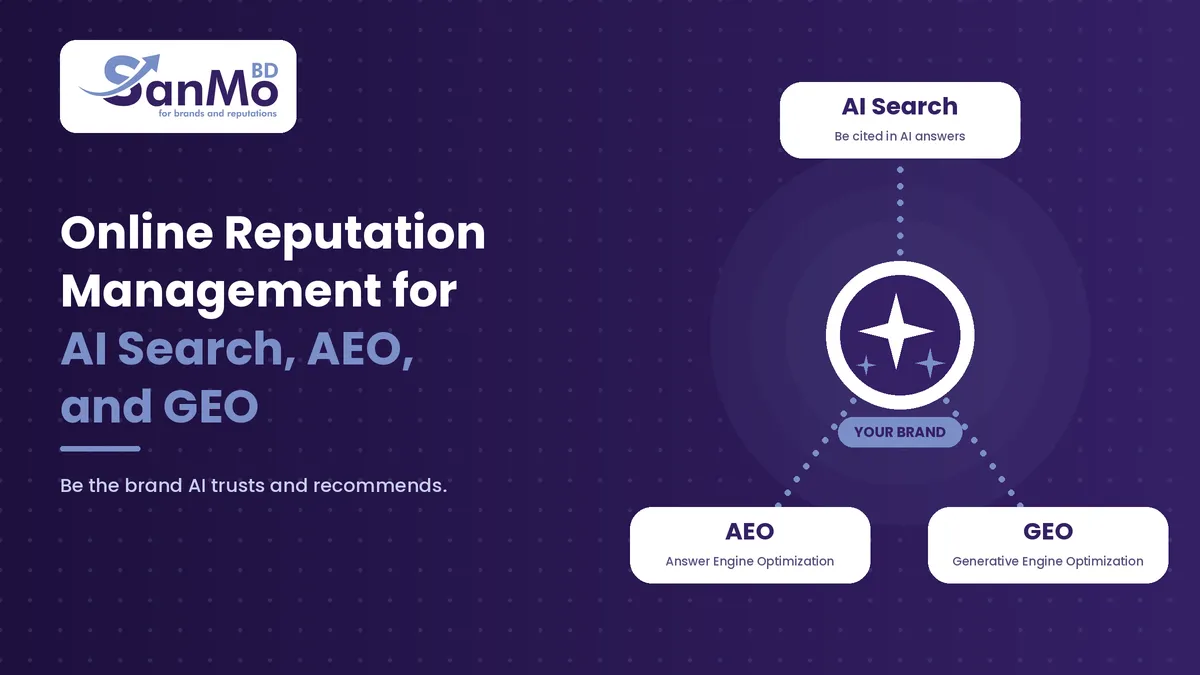
Traditional SEO helps search engines discover and rank content. Answer Engine Optimization (AEO) focuses on making information useful for direct answers, while Generative Engine Optimization (GEO) focuses on improving how content can be discovered, understood, and potentially referenced by generative AI search systems.
These disciplines overlap, but they are not identical.
What Is AEO in Reputation Management?
AEO helps businesses structure their content so that common customer questions can be answered clearly.
For example, a company might publish direct answers to questions such as:
- What is online reputation management?
- How should a business respond to negative reviews?
- Can a company remove false information from search results?
- Why should businesses monitor their online reputation?
Use descriptive headings, concise explanations, relevant examples, and FAQ sections. Each answer should be accurate and understandable without requiring the reader to interpret several unrelated paragraphs.
What Is GEO in Reputation Management?
GEO involves making content more useful and accessible for generative search experiences.
A GEO-friendly reputation management page should include clear brand information, well-organized explanations, verifiable claims, relevant examples, and links to trustworthy sources.
Businesses should also maintain consistency between their official websites, business profiles, and other legitimate sources of information.
AI systems may use different sources and retrieval methods, so no specific GEO technique guarantees inclusion in generated answers.
How SEO, AEO, and GEO Work Together
A comprehensive strategy combines the three approaches:
- SEO: Helps search engines discover and understand relevant pages.
- AEO: Makes information easier to use when answering specific questions.
- GEO: Improves content clarity and accessibility for generative search experiences.
For SanMo Bangladesh, these approaches can complement reputation management by helping businesses maintain a more useful, consistent, and discoverable online presence.
Explore SanMo Bangladesh to learn more about its digital services and reputation management solutions.
Common Online Reputation Management Challenges
Businesses face different reputation challenges depending on their industry, audience, and online activity.
Negative Customer Reviews
A negative review may highlight a genuine service problem or reflect an individual customer’s expectations. Businesses should investigate the issue before responding and avoid treating all criticism as misinformation.
A clear response and a genuine solution can demonstrate accountability.
Fake Reviews and Misleading Claims
Suspicious reviews or false statements can create confusion for potential customers.
Document the issue, preserve relevant evidence, and report content that violates the applicable platform’s policies. Avoid retaliatory reviews, fake testimonials, or attempts to manipulate ratings.
Social Media Backlash
A customer complaint can spread rapidly when it attracts attention on social media.
Businesses should verify the facts, coordinate internal communication, respond with appropriate speed, and provide updates when necessary. If the issue is serious, a designated spokesperson and an approved communication plan can help prevent inconsistent statements.
Inconsistent Business Information
Different addresses, phone numbers, business names, or service descriptions across websites can confuse customers.
Regularly review official profiles and correct outdated information wherever possible.
Negative Search Results
Negative content appearing prominently in search results can affect public perception.
The appropriate response depends on whether the content is accurate, outdated, misleading, or unlawful. Businesses may pursue legitimate correction or removal options and strengthen the visibility of useful official content.
For more advanced approaches, explore SanMo BD’s Advanced Reputation Management Services.
A Practical Online Reputation Management Strategy for Small Businesses
Small businesses do not necessarily need a complicated or expensive system to begin managing their online reputation. A consistent process can provide a useful foundation.
First, establish your baseline. Search for your business name and review your existing profiles, customer feedback, and search results.
Second, identify your priority platforms. Focus on the channels your customers actually use. A local service provider may prioritize Google Business Profile, while an online retailer may need to pay close attention to product reviews and social media.
Third, create a response policy. Define who responds to reviews, how quickly the team should respond, what requires escalation, and which situations need management approval.
Fourth, encourage honest feedback. Make it easy for customers to share genuine experiences. Never require positive ratings or offer rewards in exchange for favorable reviews.
Fifth, publish useful content. Answer common questions, explain your services, demonstrate expertise, and keep important business information up to date.
Sixth, review performance regularly. Track recurring complaints, response times, review trends, and customer satisfaction. Use these findings to improve the business itself.
Finally, use AI responsibly. AI can help summarize feedback and prepare drafts, but humans should verify facts, protect customer privacy, and make important decisions.
This approach helps businesses treat reputation management as a continuous improvement process rather than a response to occasional negative publicity.
How SanMo Bangladesh Can Help With Online Reputation Management
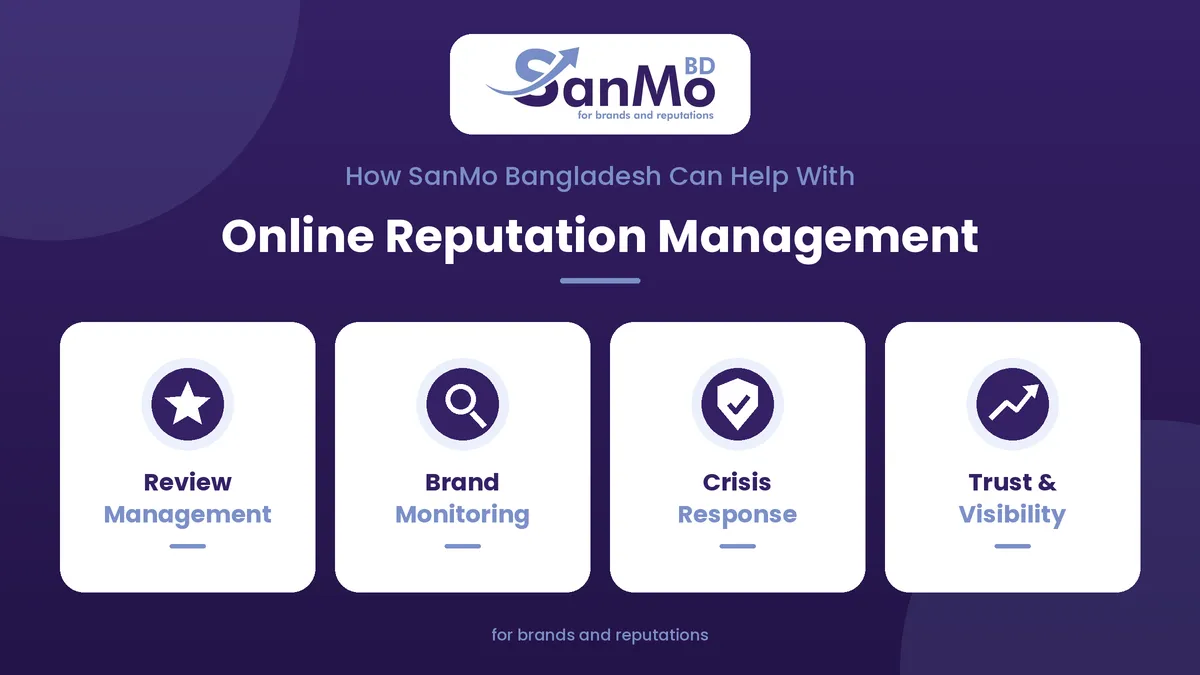
SanMo Bangladesh provides digital solutions designed to help businesses strengthen their online presence and manage their digital reputation.
Its reputation management service offering includes areas such as brand monitoring, review management, advanced reputation management, negative content management, crisis management, and personal reputation management.
Depending on a business’s specific requirements, a reputation management strategy may involve:
- Reputation auditing: Understanding how a business currently appears across relevant digital platforms.
- Review management: Organizing customer feedback and developing professional response practices.
- Brand monitoring: Tracking relevant brand mentions and identifying emerging issues.
- Content and SEO support: Improving the quality and discoverability of accurate brand information.
- Negative content assessment: Evaluating potentially harmful content and identifying appropriate correction, reporting, or visibility-management options.
- Crisis communication: Developing a structured response to significant reputation challenges.
- Ongoing reporting: Reviewing progress and identifying areas that need further improvement.
The right strategy depends on the business, the nature of its reputation challenges, and its goals. No ethical provider can guarantee that every negative review will be removed, that all unfavorable search results will disappear, or that a particular ranking will be achieved.
For businesses that want to understand their options, visit SanMo Bangladesh’s reputation management page or contact the SanMo team to discuss their requirements.
Conclusion
Online Reputation Management is an essential part of building trust, maintaining credibility, and developing a sustainable digital presence. Customer reviews, social media conversations, search results, and AI-powered discovery experiences can all influence how people perceive a business.
A successful strategy begins with understanding the current reputation, monitoring relevant conversations, responding constructively to customer feedback, correcting inaccurate information, and publishing useful, trustworthy content.
AI can make these activities more efficient by helping teams organize feedback, identify patterns, and prepare responses. However, human oversight, transparency, and genuine customer care remain fundamental to effective reputation management.
Businesses should also connect reputation management with SEO, AEO, and GEO to make accurate information easier to discover and understand across digital channels.
For businesses looking to strengthen their online reputation and improve their digital presence, SanMo Bangladesh offers reputation management and related digital services that can support a tailored approach to long-term brand credibility.
Frequently Asked Questions (FAQs)
1. What is online reputation management?
Online Reputation Management (ORM) is the process of monitoring, managing, and improving how a business, brand, or individual is perceived online. It includes review management, brand monitoring, customer communication, content strategy, and addressing inaccurate or harmful information.
2. Why is online reputation management important for businesses?
Online reputation management helps businesses build customer trust, address complaints, maintain accurate brand information, and strengthen their digital credibility. A positive and trustworthy online presence can support purchasing decisions and customer relationships.
3. How does online reputation management work?
ORM typically begins with an online reputation audit, followed by monitoring brand mentions, responding to reviews, correcting inaccurate information, improving useful content, and measuring performance. Businesses should review and refine their strategy regularly.
4. How can I improve my business’s online reputation?
Start by checking your search results and business profiles. Respond professionally to customer feedback, address genuine complaints, keep contact information accurate, encourage honest reviews, and publish helpful content that demonstrates your expertise.
5. Can online reputation management remove negative reviews?
Some reviews may be removed if they violate a platform’s policies, but legitimate negative reviews generally cannot be removed simply because a business disagrees with them. Appropriate options include reporting policy violations, responding professionally, and resolving the underlying issue.
6. How long does online reputation management take?
The timeline depends on the severity of the problem, the amount of existing content, the platforms involved, and the actions required. Some improvements, such as correcting a business profile, may happen quickly, while rebuilding trust or improving search visibility can take months.
7. What is the difference between SEO and online reputation management?
SEO focuses on improving a website’s visibility in relevant search results. Online reputation management focuses on how a brand is perceived across reviews, search results, social media, and other digital channels. Both can work together to strengthen a business’s online presence.
8. How does AI help with online reputation management?
AI can help analyze customer feedback, identify sentiment patterns, organize brand mentions, detect unusual activity, and prepare draft review responses. Human review remains important because AI can misunderstand context or generate inaccurate information.
9. What is the difference between AEO and GEO in reputation management?
AEO focuses on structuring content to answer questions clearly, while GEO focuses on making information useful and accessible to generative AI search systems. Both complement SEO by improving how relevant information can be understood and discovered.
10. Is online reputation management necessary for small businesses?
Yes. Small businesses often depend on customer trust, referrals, local visibility, and online reviews. Monitoring feedback, maintaining accurate business information, and responding professionally can help them build credibility without requiring a complicated strategy.
11. How can I measure online reputation management success?
Useful indicators include review response time, review trends, customer sentiment, brand mentions, branded search visibility, recurring complaint categories, and reputation-related leads or conversions. Metrics should be evaluated against a baseline rather than relying on a single rating.
12. How can SanMo Bangladesh help with online reputation management?
SanMo Bangladesh offers reputation management services that include areas such as brand monitoring, review management, advanced reputation management, negative content management, and crisis management. Businesses can visit SanMo Bangladesh to explore its services and contact the team about their specific needs.